



For decades, wastewater treatment has followed a simple philosophy:
The solution to pollution is dilution.
Why? Existing infrastructure and conventional treatment methods require a dilution factor to maintain reliable operations and predictable quality metrics. Big swings in pollutant concentrations can be better managed with a higher dilution factor to normalize the infeed to a given treatment plant.
Historically, predictable weather patterns and rainy seasons also helped to ensure that receiving surface waters could absorb diluted wastewater discharge with minimal ecosystem impacts.
But this approach is no longer viable.
Water efficiency programs are working exactly as designed — facilities are using less water per unit of production. But pollutant mass doesn’t shrink along with water volume. The same load of organics, solids, and process residue is now discharged in a smaller volume of water, which mechanically drives concentrations higher. A plant that cut water use 20% didn’t cut its pollutant load 20% – it just made that same load 20% more concentrated. This is the unintended consequence: the more efficient a facility becomes with water, the more concentrated – and often more expensive to treat – its wastewater becomes.
For an industrial operator, today’s lower dilution factors have particularly acute impacts on their existing wastewater treatment infrastructure that rely on conventional methods for treatment. Furthermore, manufacturers do not always have a stable production schedule, and there will be periods of fluctuating wastewater load, with the peak loads becoming higher with less dilution.
The inherent effluent variability associated with changing production schedules, plant shutdowns, and product changes, along with decreased overall water usage, leads to very significant variability in wastewater discharge from industrial sites – and potentially high surcharges or, in the worst case, a consent decree from the local utility.
Presently, every gallon leaving the production floor of a manufacturing facility is collected, combined, and sent to treatment as though it has the same characteristics.
But what if this approach is hurting more than helping? What if only a small percentage of your wastewater is actually creating the majority of your treatment costs, sewer surcharges, and compliance risks?
For many industrial facilities, that’s exactly what’s happening.
The challenge isn’t just collection and treatment; it’s visibility.
The Efficiency Paradox: The same programs that reduce water bills can quietly increase treatment costs and surcharge exposure
Wastewater is rarely generated consistently.
Wastewater volumes and compositions are constantly changing throughout the day as production shifts, equipment cycles, cleaning events, and changeovers occur.
Yet most facilities have little to no visibility into what’s happening in real time.
Instead, they’re relying on historical averages or periodic utility testing to understand a wastewater stream that can change dramatically from one minute to the next.
Without continuous monitoring, facilities often assume all wastewater should be treated equally.
In reality, that’s rarely the case.
The Hidden Cost of Treating Everything
This concentration effect compounds a second, older problem: most facilities still treat every gallon the same way, regardless of strength.
One of the biggest misconceptions in industrial wastewater management is that the entire wastewater stream requires the same level of treatment.
In many facilities, a relatively small volume of wastewater contains the majority of the pollutants, while the remaining flow is relatively clean water.
When everything is mixed, facilities end up:
- Treating far more water than necessary
- Investing in larger treatment systems
- Consuming more energy
- Generating more sludge
- Increasing operating costs
- Paying higher sewer surcharges
The result is an oversized treatment system for a fluctuating problem that only exists during specific production events.
Why Real-Time Monitoring Changes Everything
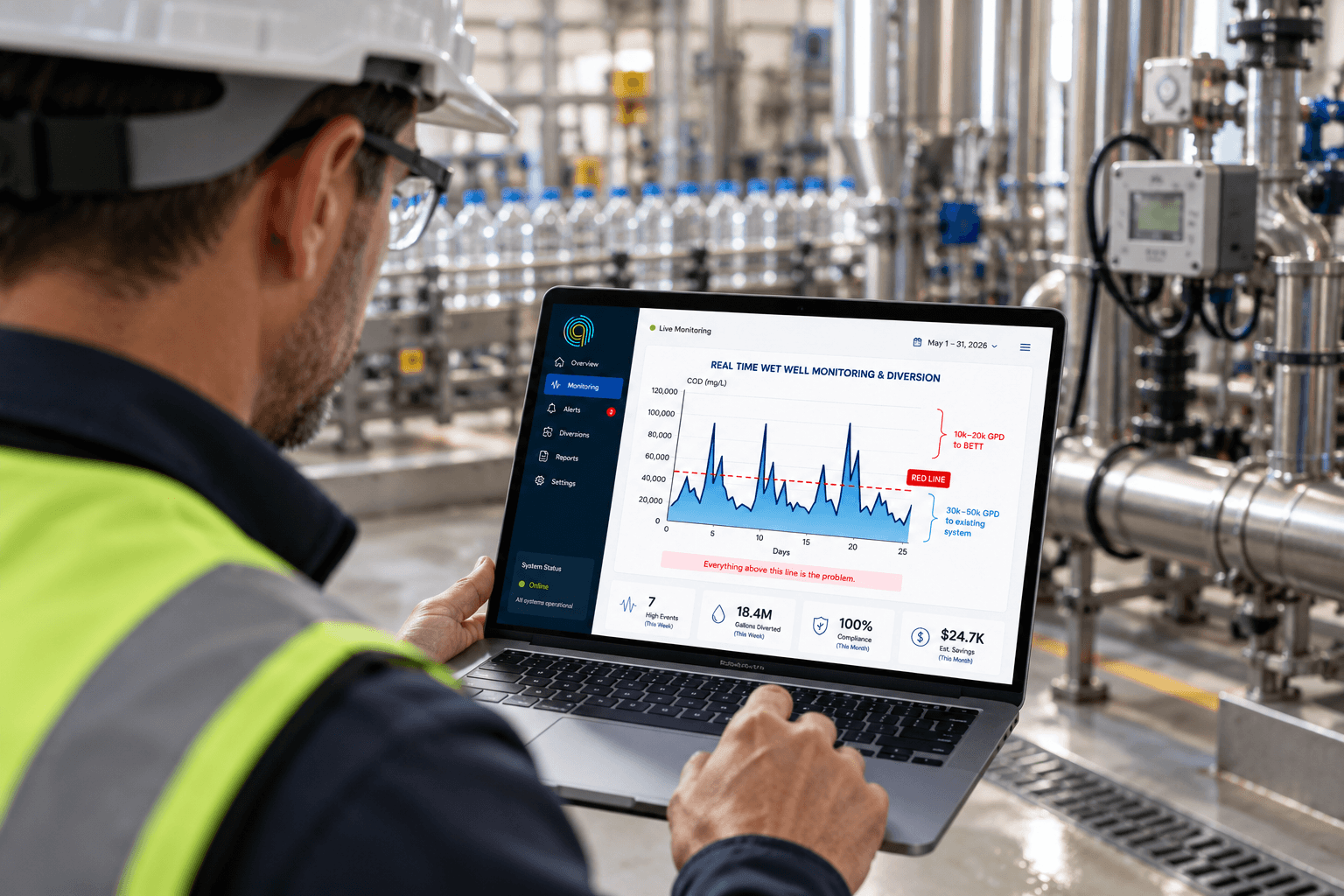
Real-time wastewater monitoring gives facilities something they’ve never had before: a clear picture of what’s actually happening inside their operation.
Instead of relying on snapshots, facilities can continuously track wastewater characteristics and identify exactly when high-strength wastewater enters the system.
This allows operators to answer questions such as:
- When are concentration or volume spikes occurring?
- Which production processes are generating them?
- How much of our wastewater actually requires treatment?
- Are production changes affecting our wastewater costs?
- Where are we losing valuable product?
- Is our treatment approach sized for yesterday’s dilution factor or today’s?
The answers often surprise people.
Your Wastewater Can Tell You What’s Happening on the Production Floor
One of the most valuable benefits of continuous monitoring has very little to do with wastewater.
Large spikes in organic loading often indicate that product—not just expected volumes of process wastewater—is reaching the drain.
That may be the result of:
- Product loss during changeovers
- Equipment malfunctions
- Automation issues
- Operator error
- Cleaning process inefficiencies
In other words, your wastewater data becomes a window into your production process.
Instead of simply reacting to higher treatment costs or sewer surcharges, facilities can identify the source of the problem and correct it at the production line.
Even facilities that aren’t ready to invest in treatment gain valuable operational insight simply by understanding what their wastewater is telling them.
From Monitoring to Diversion
Once facilities know that variable high-strength wastewater is generated, an automated diversion system can be installed to capture those flows for treatment while allowing the cleaner process water to continue through existing infrastructure.
The result is a smarter approach that can:
- Reduce treatment volume
- Lower energy consumption
- Decrease sewer surcharges
- Minimize treatment system size
- Improve operational flexibility
- Create a more scalable wastewater strategy
Instead of treating every gallon the same, facilities treat only what truly needs treatment.
A Smarter Way to Design Wastewater Infrastructure
Real-time monitoring doesn’t just improve day-to-day operations; it fundamentally changes how wastewater infrastructure is designed.
By understanding exactly where pollutants originate and how wastewater behaves throughout production, facilities can make better long-term investment decisions.
Instead of designing around worst-case assumptions, facilities can size treatment systems using real operating data—resulting in smaller footprints, lower costs, and greater flexibility as production evolves.
How Aquacycl Helps
At Aquacycl, we believe the first step toward better wastewater management isn’t building a treatment system; it’s understanding your wastewater.
We utilize sensors that are specifically designed to accurately measure high concentration peaks, above 3,000 mg/L of biological oxygen demand. We have designed specialized automation tools for self-cleaning, calibration, and data analysis to keep operations simple and data sets reliable for the busiest plant operators.
We have shown that real-time monitoring and diversion can save companies up to $300k in monthly penalties. Our Monitoring & Diversion solution continuously analyzes wastewater in real time, automatically identifies high-strength events, and diverts only the wastewater that requires treatment.
Beyond optimizing treatment, the data helps facilities identify production inefficiencies, uncover product losses, reduce operating costs, and make smarter infrastructure decisions. For many customers, the monitoring data alone delivers value long before a treatment system is ever installed.
The Bottom Line
The facilities that gain the greatest advantage won’t simply invest in better treatment technologies -they’ll invest in better information.
As industrial facilities look for new ways to reduce costs, increase revenue, improve sustainability, and increase operational resilience, wastewater monitoring is becoming far more than a compliance tool.
It’s becoming an operational intelligence platform.
Because when you understand your wastewater, you can improve far more than your wastewater system.
You can improve your entire operation.
Ready to see what your wastewater is telling you? Learn how Aquacycl’s Monitoring & Diversion solution helps industrial facilities reduce costs, improve operational visibility, and build smarter wastewater infrastructure.